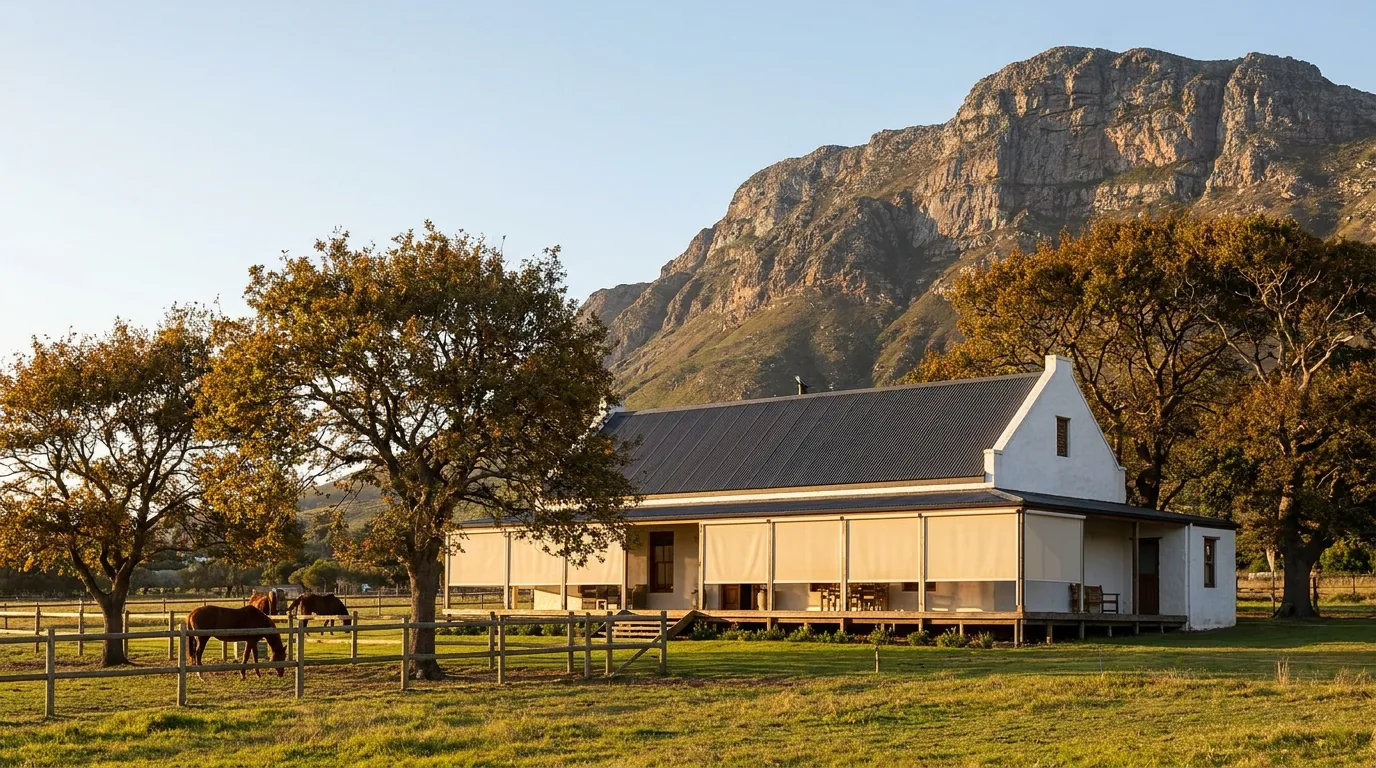
The Noordhoek field guide · Cape Town
Noordhoek is a wide, open valley pinned under Chapman's Peak with a six-kilometre beach down one side. That openness is the whole point of living here — and it's exactly what makes shading a window a local problem, not a generic one. This is our working playbook for the valley: the wind, the low afternoon sun, the Atlantic salt, the wet winter, and what we'd actually specify, room by room.
Short on time? Grab the PDF and come back to it — 11 pages.
Why Noordhoek is its own case
Noordhoek sits at about 34° south on the Atlantic side of the peninsula, below the 592-metre face of Chapman's Peak, with a six-kilometre beach along its western edge. Homes here were built to look out — at the mountain, the paddocks and the sea — which usually means big glazing on the western and south-western walls and generous outdoor rooms. That's a lovely way to live, and it puts your glass square in the path of the two things this valley has plenty of: wind and low afternoon sun. Add the salt off Long Beach and the cold, wet north-wester winters, and you have a shading brief a walled suburb simply doesn't.
So a blind that's perfect on a sheltered town bedroom can be exactly wrong on an exposed west-facing lounge here. This guide takes the problems in order — wind, low south-west glare, salt, winter damp — then gets specific about products and rooms. Every climate and geography claim is sourced at the foot of the page.
The wind & the light here
Start with the wind, because in Noordhoek it decides more than the fabric ever will. Cape Town runs on two seasonal winds and this valley catches both. In summer — roughly October to March — the dry, hard south-easter, the "Cape Doctor", pours down off the mountains for days at a stretch. In winter it flips: north-westerly cold fronts roll in off the Atlantic with rain, big swells and a rough, cold sea, gusting to severe gale strength. The steep peninsula mountains speed the wind, so an open veranda or big sea-facing pane works far harder here than inland.
Now the light. Because Noordhoek is at about 34° south, the midday sun sits in the north all year — so the north side of the house takes the steady, manageable sun, not the south. Worked from that latitude, the summer noon sun climbs to roughly 79°, almost overhead, so a modest eave shades a north window easily in December; in midwinter it only reaches about 33°, low in the north, reaching deep into north rooms as welcome warmth. The trouble is direction, not height: in a Cape summer the sun rises in the south-east and sets in the south-west, so the west and south-west glass — the aspect of most view homes here — takes the brutal, low, late-afternoon sun no roof overhang can catch. Add the light bouncing off the beach and wetland, plus Cape Town's summer UV (which runs "extreme" from about October to March, peaking between ten and two), and those late-day walls face glare, heat and fabric-fade at once.
The wind streams down the valley over the ridge — the reason an open-sided blind rarely survives here, and a captive-edge screen does.
Room by room, elevation by elevation
Before you choose a fabric, work out which way the window faces — in Noordhoek the view usually tells you. Looking at the mountain or the sea over the western half of the valley means facing roughly west or south-west, the hardest aspect to shade well. Here's how the four aspects behave here.
Steady high summer sun an eave shades cleanly; low, welcome winter sun. A sunscreen roller tames UV and keeps the paddock-and-mountain view without darkening the room. Blockout here is usually overkill outside a bedroom.
Low late-afternoon sun plus glare bouncing off the beach and wetland, on the same walls that cop the wind. This is where stopping the heat outside the glass earns its place, and where a plain interior blockout roller quietly disappoints (more below).
Summer sunrise is in the south-east, so these bedrooms get low, direct light from just after five. A blockout roller or blockout honeycomb is the honest fix for anyone who wants to sleep past dawn in December.
South rooms stay cool and take the wet winter north-wester; verandas take the wind head-on. The brief is moisture-tolerant finishes indoors and captive, wind-rated screens outdoors — not heavy blockout.
What we'd specify here — and why
There's no single "best blind" — only the right one for that window, aspect and budget. Here's how we'd think it through for the situations Noordhoek throws up. Tap Add to my list on any you're weighing up; it drops that product into the ballpark tool and ticks it on the free-measure form below, so you don't retype anything.
This is the one the valley wind decides for you — and why the home at the top of this page carries a zip screen, not a roll-down blind. Its fabric runs captive in welded aluminium side channels, so it stays flat and tensioned in wind that would flog an open-sided drop blind to pieces in a season. On an exposed stoep, that captive edge is the difference between an outdoor room you use all year and a blind you keep rehanging — sunscreen mesh to keep the view, or clear PVC to make the veranda usable through a wet winter.
The trade-off: a zip screen costs more than a simple roll-down blind, and the channels are fixed to the opening, so it suits a considered veranda rather than a quick fix. Where a spot is genuinely sheltered an open drop blind is fine — but here "genuinely sheltered" is rarer than people think, and we'll say plainly which of your openings actually is.
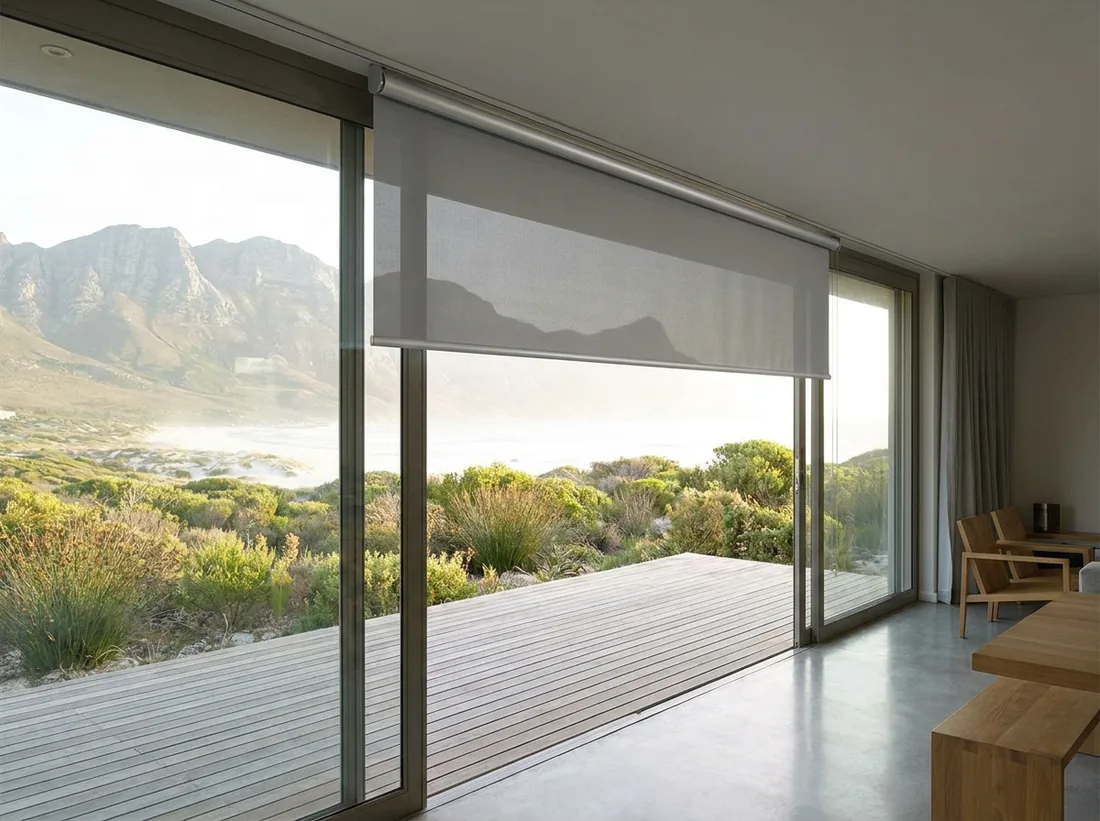
The whole reason people live here is the outlook, so on living-area glass we usually start with a sunscreen mesh: it cuts glare and UV, keeps the room bright and keeps the view of mountain, paddocks or sea. Blockout is for where you want darkness — bedrooms, a media room, the south-east side that wakes you at first light.
The trade-off: sunscreen mesh gives no full privacy after dark and won't black a room out; blockout gives darkness and a little insulation but kills the view when it's down. On a hero window the tidy answer is often a double bracket carrying both on one headrail — view by day, dark by night.
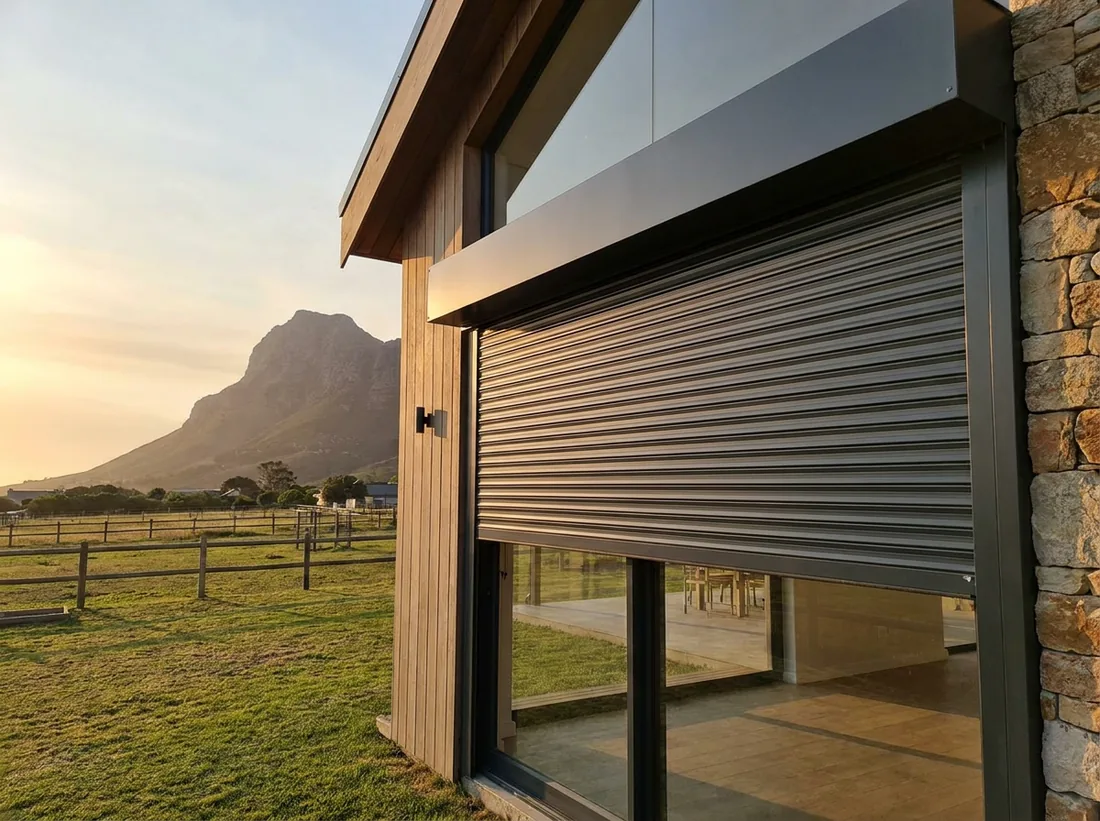
On a hot west or south-west elevation, an external roller shutter stops the sun outside the glass, so the heat never enters the room. An interior blockout roller darkens the room beautifully, but the pane behind it still heats up and radiates that warmth inward — you've blocked the light, not the heat. On this valley's late-day walls, that's real comfort in a February heat.
The trade-off: an external shutter is the bigger spend and a more involved install, and fully down it closes off the view and light entirely. An interior roller is cheaper, softer and keeps a slice of daylight. For a west lounge that overheats we lean shutter; for an occasional guest room, the interior blockout is the sensible money.
These are shading roller shutters — sun, heat, glare and light control on the outside of the glass. They are not security-rated shutters; that's a different product, available on request.
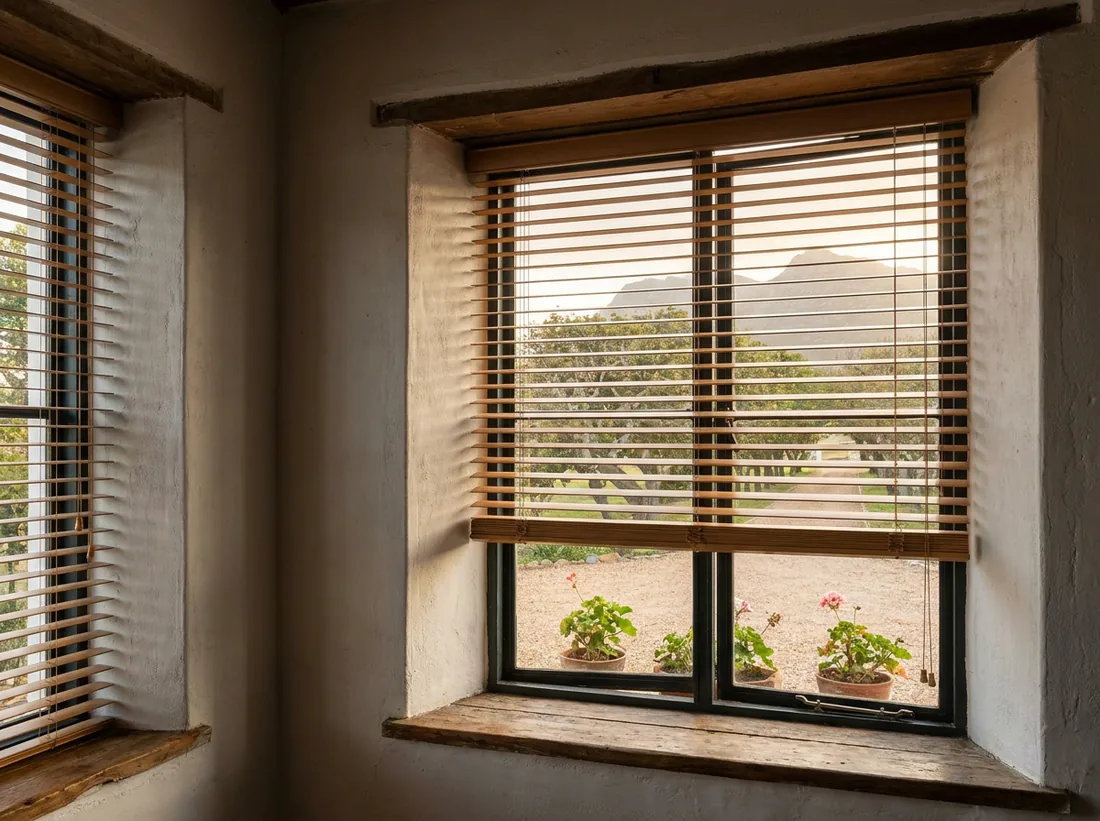
In a farmhouse living room or study, timber venetians suit Noordhoek's older Cape-vernacular homes, and the tilt gives precise control of that low afternoon light. But in a steamy bathroom or any room breathing salt air off Long Beach, powder-coated aluminium is the honest call: it shrugs off the moisture and salt that would warp or discolour timber over time, and takes a coastal-grade finish.
The trade-off: timber looks and feels softer, and away from the wet and salt it's a fair choice. Near the beach or in a wet room we'd steer you to marine-grade aluminium and 316 stainless fittings — and say plainly which finishes we wouldn't put near the sea, because salt corrodes lower-grade hardware faster than people expect.
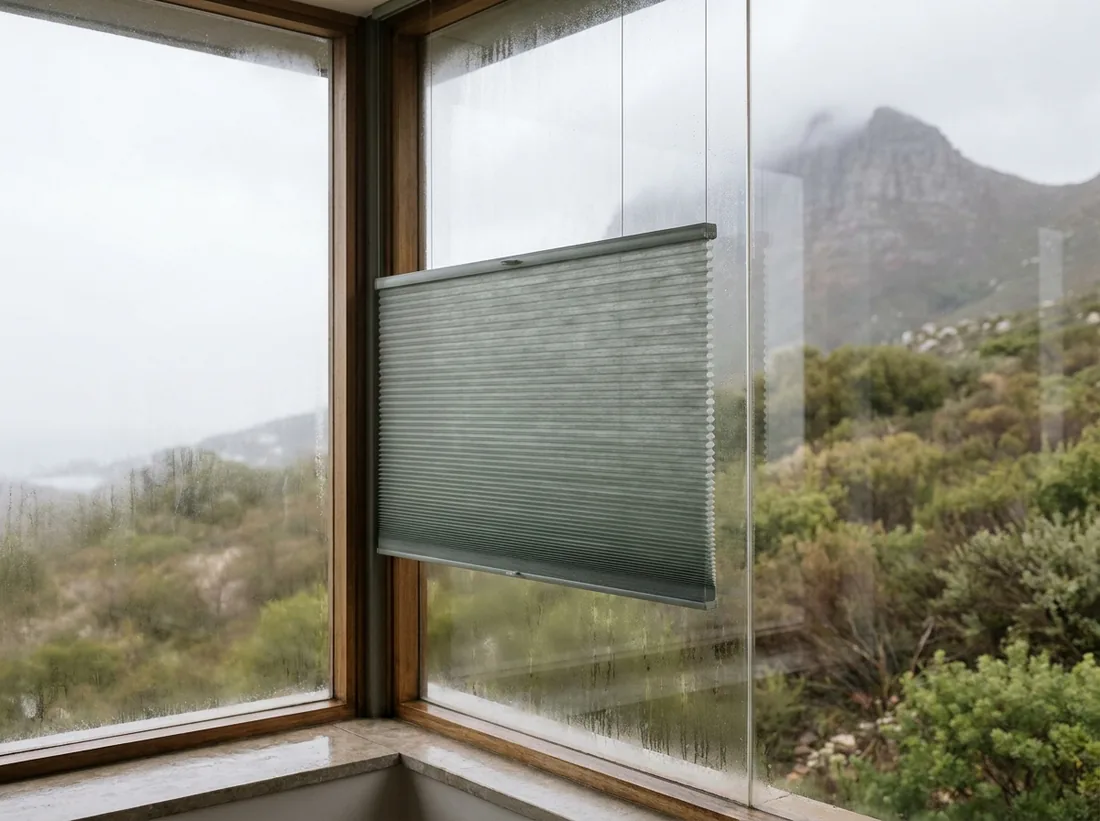
Noordhoek's winter is the wet season — north-wester fronts, a cold sea, days of grey. On the cooler south rooms and any large single-glazed pane, honeycomb cellular blinds trap still air in their cells, so they insulate far better than a single-layer roller — on a July morning, the difference between a room that holds its warmth and one that leaks it out the glass.
The trade-off: a cellular blind costs more than a basic roller, and its pleats hold a little more dust. If insulation isn't the point — a bright north room that just needs glare control — a sunscreen roller is the better-value call. Cellular earns its keep where the cold and damp do.
Day/night (zebra) rollers alternate sheer and opaque bands on one blind, so you dial from a clear view to filtered privacy without swapping fabrics — handy on a lounge that's a view by day and overlooked at night. Folding-arm awnings give a patio retractable shade you pull in when you don't want it — but in this wind, only with a wind sensor that retracts it automatically. Motorisation earns its keep on the tall, wide glass and high gables so common here: one remote instead of a stepladder, paired with sun or wind sensors. Add any to your list below.
Estate & heritage notes
Parts of the valley come with rules and character that shape what belongs on a window:
What we'd still need to check on site
Everything above gets you to a confident shortlist. But the details that decide whether a blind fits, lasts and works can only be settled at the window — which is what the free measure is for:
Two ways forward
Whichever suits you. The free in-home measure is the one we'd recommend — it settles all the on-site questions above and ends with an exact, written, per-window quote. If you'd rather just get a feel for the numbers first, pop rough sizes into the ballpark tool and we'll send a budget range by the next working day. No obligation either way, and if you're not sure how to measure, leave it — that's what the measure is for.
A consultant measures every window, checks the light, the fixings, the wind exposure and the salt, brings fabric samples to hold up in your own valley light, and leaves you with a written, itemised, per-window quote.
We take five or six measure appointments a week across Noordhoek and the deep south, so the diary tends to fill a week or two ahead — booking early just means you get the day that suits you.
Nothing pushy, and nothing binding. Add each window, and we'll send a budget range by the next working day. Not sure of a size? Leave it blank and note the room — or just book the free measure and we'll do the measuring.
| Room | Width (mm) | Drop (mm) | Fit | Product | Remove |
|---|
Sources
The climate and geography claims above are drawn from the sources below. The summer and winter sun altitudes are calculated from Noordhoek's latitude of about 34° south and the standard solar declination, so they're worked out rather than quoted; everything else is cited.
Download a copy to share with whoever else has a say in the windows.
 Noordhoek Blinds